
7th Oct 2026
Starting Lessons at Vijayadashami: Choosing a First Instrument
Vijayadashami falls on 20 October this year. In many families it is the day a child is first sat down in front of a teacher, and in a good many musical households it is the day an instrument is bought. The dates follow the commonly used panchang and may shift by a day depending on the calendar your family keeps.
The fortnight before it is when we get the question. A student is starting lessons, the family wants to buy properly rather than twice, and nobody is quite sure what properly means. What follows is what we would say across the counter.
Ask the teacher before you ask us
This is the single piece of advice that saves the most money, and it is the one most often skipped.
An Indian teacher will usually have specific requirements, and they are not a matter of taste. A tabla teacher who accompanies a particular singer will want a particular pitch. A vocal teacher will want a harmonium that sits with their own voice. A sitar teacher trained in one gharana will expect the instrument built for it. Buying first and asking afterwards is how a perfectly good instrument ends up unused in a cupboard.
Three questions to put to the teacher
What pitch should the instrument be. For tabla and for harmonium this is the question that decides everything else.
Which style or configuration do you teach on. For sitar this is the difference between two quite different instruments.
What size suits this student. For a child this matters more than any other specification.
Bring us the answers and the rest is straightforward. Bring us none of them and we are both guessing.
Tabla

Pitch, and why it is named after a harmonium key
In India the pitch of the dayan is almost always named by the harmonium keyboard rather than by letter. A teacher who says kali ek means the first black key, which is C sharp. Safed do means the second white key, D. It is worth learning this quickly, because it is the language the whole trade uses and the thing most often garbled over the phone.
For a beginner with no accompaniment commitments, teachers in our experience most often ask for something in the region of C sharp or D. If the student will be accompanying a specific singer or a specific harmonium, that pitch overrides any general advice.
Size, and children
The size of the dayan and its pitch are tied together: broadly, a smaller shell and head sit higher. This is why you cannot order a size and a pitch independently and expect both.
For a child, reach comes first. A set that is correct on paper and too wide for the hands teaches bad technique that takes years to undo. We would rather fit a smaller set now and change it in three or four years than sell a full-size set to an eight-year-old.
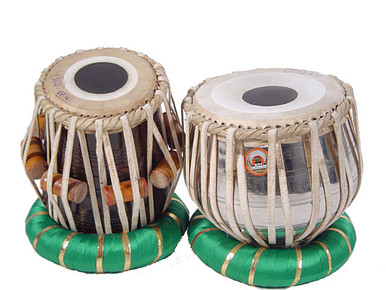
If you are replacing a head rather than buying a set, measure the shell and do not go by the number written on the old head. Our page on tabla head sizing explains why written sizes mislead, and the student and children's sets are listed under tabla sets.
Harmonium
Scale changer, or not
A scale changer lets you shift the whole keyboard so that the same fingering produces a different key. It is genuinely useful for anyone accompanying several singers. It is also heavier, costlier and has a mechanism that can go out of alignment.
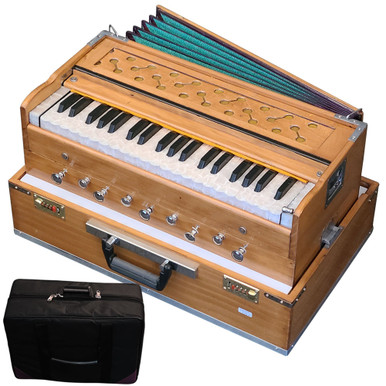

For a first instrument, for a student learning to play rather than to accompany, a well-made fixed-scale harmonium is usually the better buy. The money saved on the mechanism is better spent on reeds and bellows, which are what you actually hear.
What to listen for
Pull each drone stop on its own and listen for whether it speaks at once or hesitates. Then go through the keyboard note by note rather than playing a phrase, because a phrase hides a weak note. Pump a dozen times with all stops closed in a quiet room: a faint hiss means air is escaping somewhere.
Be careful about brand names. The well-known names are widely copied, and a copy carries the right badge and the wrong insides. The harmonium buying guide sets out what to check and what the different ranges actually get you.
Sitar
Two instruments, not one
A Ravi Shankar style sitar, kharaj pancham, has seven main strings, thirteen sympathetic strings and usually an upper gourd. A Vilayat Khan style instrument, gandhar pancham, drops the two lowest strings and normally has no upper gourd. These are not variations on a theme. A teacher from one tradition will expect the instrument from that tradition, so this is a question to settle before you look at anything.

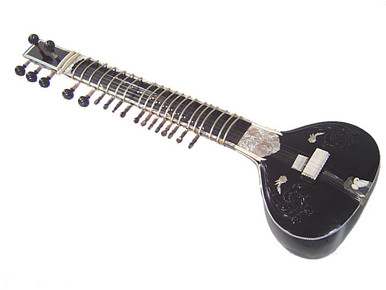
Beyond the configuration, what decides whether a sitar is worth owning is the jawari, the curve of the bridge that gives the instrument its voice. That is bench work and it does not show in a photograph. The sitar buying guide covers what to look for, and our guide to makers explains what the Kolkata, Miraj and Delhi workshops are each known for, which is useful background whether or not you buy from us.
If the student is very young
A bansuri is often the gentlest beginning. It costs little, it needs no tuning in the way a drum or a reed instrument does, and it teaches breath and pitch together.

The one caution is size. A long bass flute has a beautiful sound and finger holes a child cannot span. Start with a middle-size instrument that the hands can cover comfortably, and let the long ones wait. Our bansuris run from inexpensive student flutes to professional instruments.
Buying this month
We deliver across India in seven to ten days for most products, so an order placed now arrives in good time for a Vijayadashami start. Payment is by UPI, card, cash on delivery or EMI.
We also ship worldwide from Mumbai, insured. For customers outside India, please note that we cannot accept returns on international orders, because two-way freight on an instrument can cost more than the instrument. What we do instead is stay with it: send a photograph or a short video, or ring, and we will work through setup, tuning or a fault with you on the phone, on WhatsApp or on a video call.
Where to start
If the student is taking up tabla, start with the sets and bring us the pitch the teacher has asked for. For harmonium, read the buying guide before you compare prices. For sitar, settle the style question first and read the buying guide second.
If you would rather just ask, send a WhatsApp message or ring 98335 99433. Tell us the instrument, the student's age and what the teacher has specified. Those three things answer most of it.