
A harmonium is the most forgiving instrument in Indian music to start on and one of the easiest to buy badly. The keyboard tells you nothing: two instruments that look identical on a shelf can be separated by ten years of working life. This guide is what we say to people who come into our Mumbai showroom, set out so you can use it wherever you are buying from.
Harmoniums by budget
Below about fifteen thousand rupees
We would rather you did not. At this level the reeds are poorly voiced, the bellows leak within a year or two, the keys are uneven and the instrument will not hold its tuning. It is the classic false economy: you spend the money, lose interest because the instrument is unrewarding to play, and end up buying again. If your budget is genuinely here, buy a good used instrument rather than a cheap new one, or consider a surpeti to practise against while you save.
Around eighteen to thirty thousand rupees
This is where most people should be, and where the most popular instruments in India sit. A properly made two or three reed harmonium in this band will have voiced reeds, a bellows that holds air, a coupler, and a keyboard that is even under the hand. It is enough instrument to accompany singing, to lead kirtan and to take you through many years of learning. The Bhargavas Kirtan Deluxe, the Bina 23B and the Bhargavas 3 Reed Fold Up all live here.
Forty to fifty thousand rupees
Premium two and three reed instruments. What you are buying is refinement rather than extra features: quieter and smoother bellows, better matched reed sets, a more even keyboard from bottom to top, and finish and hardware that survive being carried about. The Paloma fold-ups and the Dulcetina are the instruments we sell most often at this level.
Fifty-five thousand rupees and above: scale change
A scale change harmonium slides the entire keyboard sideways over the reed board, so you can play the same fingering in a different key. For anyone accompanying singers with different ranges it is transformative. It is also the most mechanically demanding kind of harmonium to build, which is exactly why it should only be bought from a workshop that has been making them for decades. See scale change harmoniums.
Seven checks on any harmonium
This video walks through seven quick tests that will tell you whether an instrument is sound. They are worth knowing whether you are buying, or checking one you already own.
What to look for when you buy
The sound
Play every note, slowly, one at a time, and then in octaves. Listen for a note that is weaker, slower to speak or sourer than its neighbours. Then hold a chord and listen to whether the instrument sits comfortably with itself. Tone is personal, but evenness is not: an uneven harmonium is a faulty one.
The keys and the bellows
The keys should return smartly and feel the same under every finger. The bellows should fill easily, hold air when you stop pumping, and be silent. A hiss means perished cloth or a leaking valve. If you have to work hard for volume, something is wrong.
Who you are buying from
More than with any other instrument, the seller matters. The well-known names are copied, and a copy will have the right badge and the wrong insides. Buy from a shop that opens the instrument, checks it and will tell you where it came from. We say on every listing who made the harmonium we are selling.
Known weak points
Ask specifically about the reed board seal, the coupler, and on a scale change instrument the sliding mechanism. Those three are where a cheap harmonium fails. Our harmonium FAQs cover them in more detail, and harmonium repair explains what can be put right later.
What we do before an instrument is despatched
Every harmonium we sell is opened and gone through in Mumbai. We check the reed board for leaks, free and level every key, inspect the bellows cloth and valves, tune the instrument to A440, and play it right through listening for anything sluggish. Then we pack it for the journey it is actually making, because an instrument going to Pune needs different packing from one flying to Frankfurt.
What to check the day it arrives
- Unpack it on a table, not the floor, and look over the case and the corners of the instrument before anything else.
- Pump the bellows gently a dozen times before playing, to wake the leather up.
- Play every note in turn and listen for one that is silent, slow or off.
- Test the drone stops and the coupler.
- Give it a day in the room before judging the tuning. Instruments that have travelled need to settle, especially into a dry climate.
If anything is not right, tell us straight away with a short video. Within India we will sort it out. If you are abroad, we will diagnose it with you over a video call and send whatever part is needed, because sending a harmonium back across the world costs more than the fault is worth.
The harmoniums we carry
Bhargavas
Our own range, built to our specifications by craftsmen in Kolkata, Delhi and Mumbai. It exists because musicians kept asking for things they could not buy.
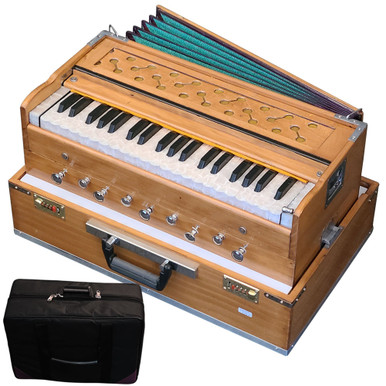
The Bhargavas Kirtan Deluxe at around eighteen and a half thousand rupees is the instrument we sell more of than any other, and the one we recommend to most students and kirtan singers. Loud enough to lead a room, light enough to carry every week.
The 3.5 octave version adds range for players who accompany a wide variety of singers and want the extra bass.
The Bhargavas Kirtan Mini and the Harinam travel harmonium are for people who move: small enough to take on a flight or a train, and still properly voiced rather than a toy.
Paloma
Paloma is where we send players who want a noticeably finer instrument without moving into scale change money.
The 2 reed fold up is the lighter, sweeter of the pair and the easier to carry. The 3 reed fold up adds body and volume, at some cost in weight, and is the better choice if you accompany singing in large rooms.
The Dulcetina is the softest-voiced instrument we stock, made for recording and for small rooms where a full harmonium overwhelms the singer. The Paloma Mini is a standalone compact instrument with a surprisingly full tone for its size.
Bina
Delhi’s best-known harmonium name and the default for kirtan worldwide. The 23B, the 23B Deluxe, the compact 23B Mini, the Sangeet 3.5 octave and the Bina 17. Sweet toned, portable and reliable. See all Bina harmoniums.
Paul & Co. scale change
Widely considered the finest harmoniums made in India, and the reference point for scale change instruments. The keyboard action, the sustain and the voicing of the reeds are in a different class, and so is the price.

The 3 reed 9 scale is the most popular configuration: enough scales for almost any accompaniment, in a folding instrument you can still carry.

The 11 scale version extends the range further for professional accompanists, and we also stock the 7 scale for players who want a lighter instrument.
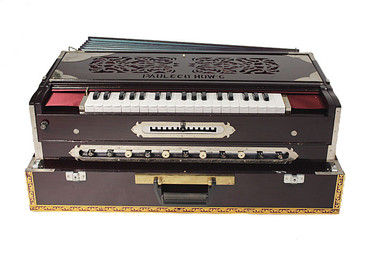
The 4 reed 13 scale is the top of the range: four reed sets, the full complement of scales, and the finest finish. If you are buying one instrument for a professional career, this is it.
A word of warning that we repeat often: H. Paul & Co. is a different company from the original Paul & Co., and copies of both are sold. Buy where the provenance can be stated.
Buying from us
We are in Mumbai, close to the workshops, and we open and check every instrument before it goes out. You can pay by UPI, card, cash on delivery within India, or EMI. We deliver across India in seven to ten days and ship worldwide from Mumbai, insured and braced. If you would like to hear a specific instrument before deciding, ask and we will record it for you.
Browse all harmoniums, or go straight to kirtan, classical, scale change and surpetis. Read the harmonium FAQs or write to us with your budget and what you play, and we will tell you honestly what is worth buying.